Paradise Lost: American Investor Blows Whistle In Explosive 16-Page Criminal Complaint Accusing Costa Rican Officials of Organized Crime and Investor Assassinations
- Uncategorized
Enzo Vincenzi
- June 18, 2026
- 0
- 1428
- 10 minutes read
Paradise Lost: American Investor Blows Whistle
This is no ordinary grievance. Vincenzi’s complaint is framed as both a legal denunciation and a public call to arms, supported by certified mail receipts, financial records, public registries, and photographic evidence. It paints a chilling portrait of a tropical paradise turned predatory trap for foreign investors, where bureaucratic delays mask alleged corruption and violence.
The Spark: A Alarming Judicial Response
The immediate trigger for the June 11 complaint occurred on June 10, 2026, at approximately 11:34 a.m. Vincenzi received a response from Judicial Technician Cristopher Hernán Vega Álvarez regarding multiple prior criminal complaints involving allegations of international terrorism, organized crime, and narcoterrorism. Instead of addressing the substantive evidence—witness statements, financial records, and documentation previously submitted through official channels—Vega Álvarez allegedly focused solely on procedural technicalities.
According to Vincenzi, this response exemplifies a broader, repeated pattern of obstruction. He asserts that complaints sent via certified mail to the OIJ (Organismo de Investigación Judicial) agent Donaldo Bermúdez Rodríguez and other authorities have been repeatedly acknowledged but never meaningfully investigated.
“The complaints are filed. The evidence is delivered. Governmental records are created. The authorities acknowledge receipt. No significant accountability follows,” the document declares. (Translated from Spanish)
Vincenzi argues that each bureaucratic delay deepens the perception that certain individuals are being shielded from accountability while American investors are left financially devastated, facing unpaid bills for food, medical expenses, utilities, and inflated property taxes.
Named Accusations: A Web of Alleged Corruption
At the heart of the complaint is Cristopher Hernán Vega Álvarez, whom Vincenzi repeatedly labels as “públicamente corrupto” (publicly corrupt) and allegedly tied to narcoterrorism within the Jacó Police Department. Vincenzi claims Vega Álvarez manipulates official records in his possession, issues false police reports filled with lies, and facilitates extortion and property seizures.
The complaint further accuses several lawyers of direct involvement: Eduardo Mora Cascante, Yorleni Díaz, Cristian Eduardo Zamora Sequeira, José Juan Sánchez Chavarría, Andrea Díaz, Junior Díaz, Juan Calderón Díaz, and the previously arrested Mónica Gabriela Sánchez Valverde. Also referenced is the late lawyer José Antonio Calderón Vargas, known as “el abogado del diablo,” allegedly murdered in narcoterrorism-related events.
Additional officials named include prosecutors Norma Cayasso and Eduardo Mora Cascante, Judge David Ricardo Madrigal, and Jacó Mayor Francisco José González Madrigal. These individuals are accused of participating in exploitation through inflated real estate taxes, penalties, and interest, while allegedly aiding false arrests, expulsions, robberies, and murders of American investors to seize prime coastal properties.
Vincenzi highlights a stolen Wells Fargo check for USD $35,000 and a press photograph of a narcoterrorism-related murder victim as key pieces of evidence allegedly held by these officials. He emphasizes that public governmental records make these connections visible to the world.
Personal Toll and the Investor Exodus
Vincenzi positions himself as both victim and witness. As owner of Ocean Beach Jaco Hotel Residential, located behind Plaza Coral in Jacó, he says he has poured significant capital into Costa Rica’s tourism economy—over a million dollars collectively with other Americans—only to face relentless attacks. He claims public defamation, discrimination, psychological manipulation, and death threats have forced many U.S. citizens to abandon the country.
The complaint references a U.S. Embassy Security Alert detailing crimes against foreigners, including armed robberies, home invasions targeting Airbnb properties, and extortion schemes forcing victims to withdraw large sums from ATMs. It also links to videos discussing the “Exodus of Expatriates” from Costa Rica, underscoring a growing crisis of confidence in the nation’s institutions.
“Every failure to investigate credible accusations sends an absolutely clear message,” Vincenzi writes, “that foreign investors can be deprived of their real estate properties, assaulted, attacked, and murdered.” (Translated from Spanish)
Spiritual Warfare and Public Denunciation
What sets this complaint apart is its unapologetic spiritual framing. Vincenzi signs as a U.S. citizen, investor, businessman, ordained minister, and “guerrero de fuego de Dios” (God’s Warrior of Fire), invoking Ephesians 6:12: “For our struggle is not against flesh and blood, but against the rulers, against the authorities, against the powers of this dark world and against the spiritual forces of evil in the heavenly realms.”
Biblical quotes punctuate the document: John 10:10 on the thief who comes to steal, kill, and destroy; Luke 11:52 condemning lawyers who have taken away the key of knowledge; and Isaiah 5:20 warning against those who call evil good and good evil. He calls upon “Justicia Divina” (Divine Justice) alongside earthly authorities.
Vincenzi has chronicled his experiences in the book God’s Warrior of Fire: Surviving Corruption and Betrayal, available on Apple Books, which he presents as both personal testimony and exposé of Costa Rican institutional corruption, including alleged links to drug-related sorcery and satanic masonry influencing politics.
Evidence and Distribution: A Strategy for Global Scrutiny
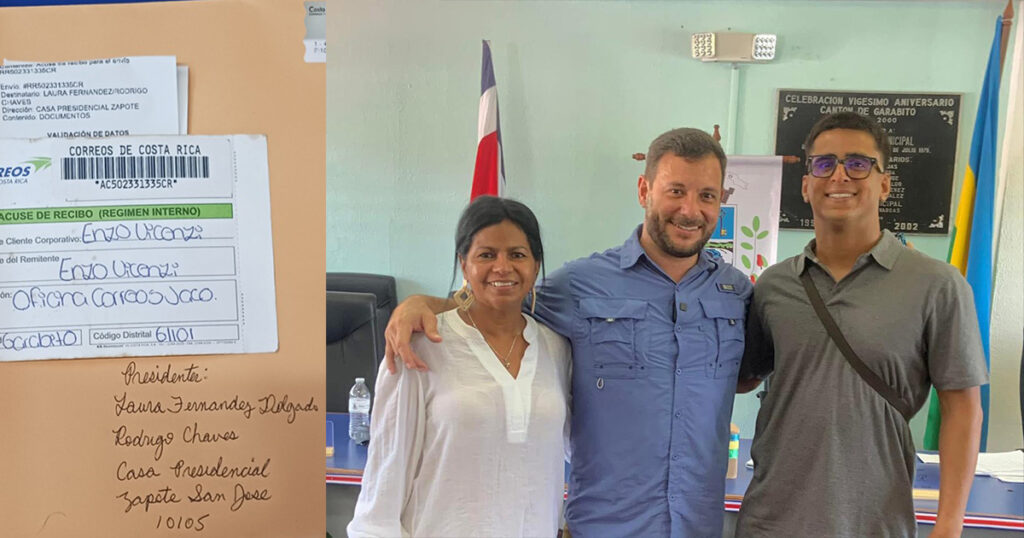
The complaint is bolstered by concrete documentation. Multiple pages feature images of certified postal receipts from Correos de Costa Rica, showing registered deliveries to President Fernández, Rodrigo Chaves, and Cristopher Hernán Vega Álvarez. One receipt details a large certified mailing with numerous tracking numbers. Other visuals include news screenshots of arrested lawyers, social media posts (such as Yorleni Díaz celebrating an election), official OIJ documents, and a book cover promoting Vincenzi’s publication.
The distribution list reads like a who’s who of power: President Trump (with mailing address in Palm Beach), Secretary of State Marco Rubio, FBI Director Kash Patel, DEA head Terry Cole, CIA Director John Ratcliffe, DNI Tulsi Gabbard, Governor Ron DeSantis, Interpol, and numerous U.S. military and diplomatic entities. Costa Rican figures including judges Maureen Víquez Córdoba and Douglas Quesada are also copied.
Vincenzi references security pacts between Presidents Bukele and Chaves, and public statements by Chaves about enemies embedded in judicial offices, as contextual support for international cooperation.
International Ramifications and Demand for Action
The stakes extend far beyond one investor’s battle. Vincenzi warns that unchecked corruption damages Costa Rica’s reputation as a stable democracy and investment destination. He calls for independent international investigations, immediate arrests, and extraditions to the United States, citing the precedent of Judge Celso Gamboa’s arrest.
“If the accusations here presented are false, they must be investigated and refuted,” he states. “If the accusations are true, those responsible must be held accountable, arrested, and extradited.”
The document ends with blessings for the United States, El Salvador, Costa Rica, and U.S. Armed Forces, and says it is imperative that installation of Military Bases is necessary to combat alleged narco-terrorism and Organized Crimes against U.S. investors, Foreign investors and even Costa Rican citizens who have also alleged being robbed of their real estate properties.
A Turning Point for Justice?
Enzo Vincenzi’s complaint arrives at a sensitive moment. Costa Rica has long prided itself on peace and eco-tourism, yet rising crime statistics, particularly homicides, have raised alarms. Foreign investors, once welcomed, now report feeling targeted. Vincenzi’s case—amplified through public registries, media distribution, and his published book—could force long-overdue scrutiny.
Whether this becomes a landmark case for transnational justice or another unresolved file depends on how authorities respond. Silence, procedural dismissals, or further delays will only fuel suspicions of institutional complicity, as Vincenzi has warned.
For now, the world is watching. American investors, human rights organizations, investigative journalists, and diplomatic channels have been placed on notice. The paradise of Jacó may soon face a reckoning that could reshape Costa Rica’s relationship with foreign capital and its own rule of law.
Enzo Vincenzi – Ocean Beach Jaco Hotel Residential Jacó, behind Plaza Coral
Email: [email protected]
Author of God’s Warrior of Fire – Available on Apple Books, and Barnes and Noble